
The Key Parameters of Jumper Cables
Jumper cables are only as good as their key parameters: amperage, wire gauge, length, core material, insulation and clamp quality. Learn the six parameters that determine a safe jump start.
1. Current Rating / Amperage
This is the most critical parameter. It determines how much electrical current the cable can handle without overheating or melting. Common Value Ranges: 200-2000A.
Explanation: Higher numbers indicate stronger starting power. generally, 200-400A is sufficient for compact sedans, while SUVs, trucks, or diesel engines usually require 500-800A or higher.
2. Wire Gauge / Thickness
The gauge determines conductivity efficiency. Thicker wires offer less electrical resistance, allowing current to flow more smoothly. Measurement Units:
- AWG (American Wire Gauge): The lower the number, the thicker the wire. Example: 10 Gauge (Thin), 1 Gauge (Very Thick).
- Cross-sectional Area (mm²): The higher the number, the thicker the wire. Common range 6-50mm².
Note: If you buy longer cables, you must choose a thicker wire (lower AWG number) to prevent voltage drop. 4 AWG or 6 AWG cables are recommended for general versatility.
3. Cable Length
Refers to the reach distance of the cable set. Common Values: 10ft (~3m), 20ft (~6m). Explanation:
- Too Short (<10ft): Requires the two cars to be bumper-to-bumper, which can be difficult to maneuver.
- Ideal (12ft - 16ft): The recommended length. It allows for jump-starting even if the cars are parked side-by-side or nose-to-nose.
- Too Long (>20ft): Without extra-thick wire, the voltage drop will be significant, leading to weak starting power.
4. Conductor / Core Material
Determines conductivity and durability. Common Types:
- Pure Copper (100% Copper): Best conductivity. Remains flexible even in freezing weather. Most expensive.
- CCA (Copper Clad Aluminum): Aluminum core coated with copper. Cheaper and lighter, but has lower conductivity (requires a thicker gauge to match copper).
5. Insulation Material
The protective coating wrapped around the metal core. It determines safety and flexibility in cold weather.
Common Materials: PVC, TPE, Rubber.
Key Feature: Low-temperature flexibility. Cheap insulation becomes stiff like a stick in winter (e.g., -10°C) and cracks easily. High-quality cables remain flexible even at -30°C.
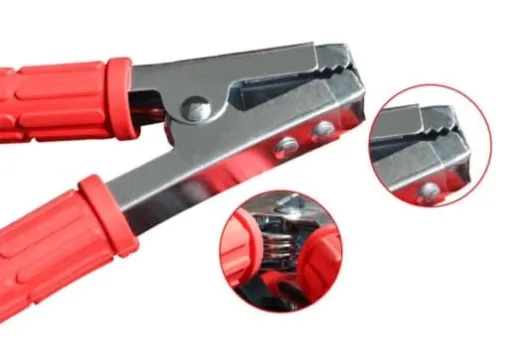
6. Clamp Quality
The clips (alligator clips) that connect to the battery terminals. Key Indicators:
- Grip Strength (Tension): The spring should be strong to ensure a tight connection.
- Insulation: The clamps should be fully coated to prevent accidental short circuits if they touch metal parts of the car.
- Jaw Material: The teeth/jaws should ideally be pure copper or copper-plated for better conductivity.
Quick Selection Guide
Vehicle Type Recommended Amps Recommended Gauge (AWG)
- Compact Car / Sedan: 200-400A, 8-6 AWG
- Mid-size Car / SUV: 400-600A, 6-4 AWG
- Large Truck / Diesel / Pickup: 800A+, 4-1 AWG
Summary: When buying, prioritize AWG (Wire Gauge) and Core Material. Even if the packaging claims "1000 Amp," if the wire is thin or made of aluminum, it will perform poorly. Purchasing a thicker Pure Copper cable (e.g., 4 or 6 Gauge) is the safest and most reliable choice.
Looking for the right jumper cables for your market? Contact us for specifications and wholesale pricing.